Analog living is the answer to digital overwhelm. Analog living requires extra boundaries around your phone and other digital engagement and a little hope and curiosity.
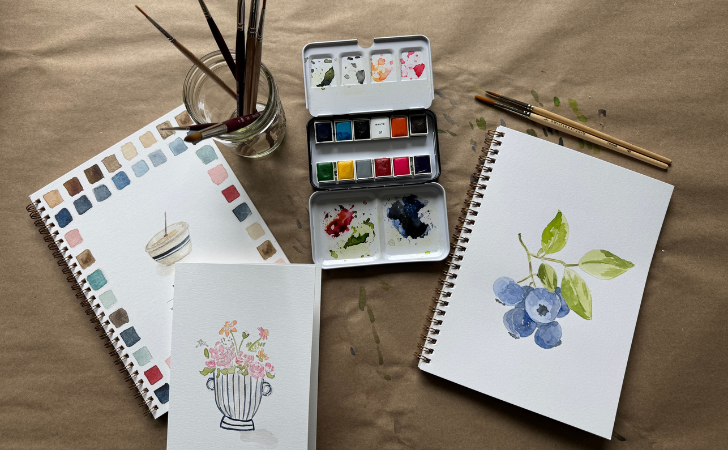
I recently covered my kitchen table with brown craft paper, and put all of my watercolor supplies on display. I wanted to them to be easily accessible and in my face. Now, before picking up my phone, I pick up a paint brush.
Picking up my phone is easier. Painting is way more fun. What you pick up might be different. You might want to pick up a book, a good cupcake recipe, a game or something else that doesn’t come with a screen. It may help to get your phone out of sight too to reduce the temptation to scroll first.
Set The Stage for Analog Living
If you want to spend less time online and more time enjoying the world around you, consider these two steps for Analog Living.
ONE. Create boundaries about how much time you spend on screens.
Set better boundaries about how much time you spend time online, checking your phone and scrolling social media or the news. It can be all consuming unless you set clear times and spaces for your digital engagement. For instance, commit to a screen-free day once a week. If that feels too hard, try once a month at first. Then decide how long you want to be online and use a timer to remind you to stop after a certain amount of time.
TWO. Romanticize Analog Living.
Create beautiful rituals around things that bring you joy. Making and enjoying your morning coffee and your favorite book is more romantic than shuffling through email checking Facebook drama. You’ll enjoy this secret to reducing screen time too.
9 Ways to Unplug and Reconnect With What You Enjoy
Every suggestion below can be a simple pleasure. They will help you use analog living to stretch time, to fall in love and to do the things that bring you real joy. Sometimes we get so busy and so overwhelmed that we forget how the simplest things can make us smile the most. We often save those simple things for when we “get everything done” or think we’ve earned or deserved them in some way. Instead, give them to yourself.
1. Carry a notebook instead of searching online.
The answer to anything and everything is right at your fingertips. While this can be helpful and informative, it can also be overwhelming and limit your own creativity and curiosity. It’s ok not to know everything all the time. I noticed a big difference when I stopped answering every question my brain thought up.
For a while, I thought searching was making me smarter but instead it was only soothing my compulsive need to know things I didn’t really need to know. Remove your web browsers or limit your access to them for a set period of time. Carry a notebook instead and when you have a question you would normally search for, write it down. If you still care later in the week, do one search session for all of your questions instead of stopping a conversation or activity for immediate answers (that may or may not be true or helpful).
2. Prioritize phone-free mornings.
This is part of boundary setting with your digital devices. Instead of starting your day with the thoughts of the entire internet in your head, connect with yourself first. Pretend the internet or your phone is broken for the first ten minutes to two hours of each day. If you’ve never done this before, start with ten minutes. If work gets in the way, try this practice from dinnertime on or a more convenient time.
You may even want phone-free times in the morning and night. Also notice where you are spending your time. If there is a main offender, remove that app from your phone for a while and see what happens. It really helps to remove your phone from your line of vision. I love putting my phone in jail (on a charger in another room).
3. Be green adjacent.
From watering your plants or walking through a park to going for a hike, getting by the trees and into the green (preferably somewhere with limited wifi), you’ll notice yourself breathing a little deeper, smiling more and feeling more relaxed. When you are feeling anxious from your digital scrolling, give your houseplants extra attention. Wash their leaves, play them some music and calm your nervous system. For a fun romantic afternoon, stroll through a local plant shop or greenhouse admiring the different variety of plants.
A 2022 Washington Post article looked at several studies in an article titled, “What Science Tells Us About the Mood-Boosting Effects of Indoor Plants.” It cited research suggesting that house plants can have an impact on our physical and psychological health. In one experiment, participants who spent even five to ten minutes in a room with a few houseplants felt happier and more satisfied than those in a room without plants (this is certainly my experience).
4. Create micro-adventures.
You don’t need a month-long vacation to a remote island to spend less time on your phone and embrace analog living. You can create micro-adventures in your own backyard where your phone is not invited. Have a picnic in your backyard or visit a local museum. Take a walk with friends or a silent, solo walk. See what your community is offering that would fit into the micro-adventure category and try something new. As the saying goes, do more things that make you forget to check your phone.
5. Go where the books are.
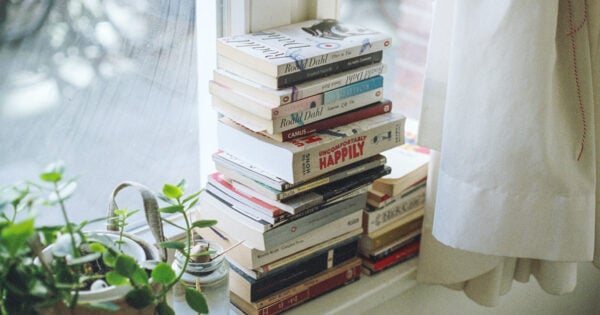
Books are a beautiful simple pleasure. Visit your local library and bookstores. See if Gentle is available or another one of your future favorite books! Chances are your local bookstores host a variety of author events to attend and enjoy. You could also start or join a book club and get the benefit of reading and creating community. Hanging out with people who love books is always a good idea.
If you are just getting back to reading, take your time. Years ago, my daughter, Bailey, wanted to develop a reading habit. She committed to reading “something” even if it was just one sentence every day for a year. That’s a tiny step! Some days she read much more, but it was always at least a sentence. Today, she reads more than fifty books a year, hosts a book club, and is an incredible supporter of new authors. That habit and her passion for books started with one tiny step: reading “something” every day. If she had committed to a book a week or a chapter a day, or even a page a day, it wouldn’t have been tiny enough to create a habit. These books will help if you are in a reading slump.
6. Be old fashioned and read the newspaper.
Instead of skimming or doomscrolling the horrifying headlines of online breaking news. Subscribe to a newspaper. My experience is that daily delivery is overwhelming to keep up with but getting a newspaper every Sunday is perfect. Brew your coffee or tea and enjoy the paper. I prefer to toss the first section and skip right to arts and leisure. You might choose to subscribe to your favorite magazine instead of trying to navigate it online. It’s a very different experience than consuming content online.
7. Try a Little Saturday.
In Gentle, Rest More, Stress Less and Live the Life You Actually Want, I wrote a chapter called Little Saturday. The chapter is about rituals you can create to be gentle and enjoy your life. In the Nordic tradition, Wednesdays are called Lillördag, which means “Little Saturday.” They’re regarded as opportunities for mini weekend-like activities.
While celebrating Lillördag isn’t an exact science, it helps to break up the workweek and is a reminder that we don’t have to wait for the weekend or a vacation to enjoy ourselves. We often celebrate our Little Saturday with sushi and a great movie. You could celebrate in any number of ways. It’s an opportunity to decompress before the weekend. Perhaps Mondays won’t feel so Monday-ish if we know a celebration is coming on Wednesday.
8. Reach for a paint brush.
The water color painting I’ve been doing has been so easy and satisfying. These watercolor books and sets offer beautiful outlines of images and suggestions for mixing paint. It’s perfect for beginners and people who are more advanced who are starting again.
If painting isn’t your thing, what else would you like to create? I saw something floating around the internet that said something like, “Humans were designed to create. This is why you get depressed when all you do is consume.” I understand consuming to mean not just shopping but scrolling too. These 27 things will feel better than scrolling ever will.
9. Send notes, postcards and care packages.
Email gives me more work vibes than love and connection vibes. We’re so focused on being productive in email that it doesn’t feel like a simple pleasure. Analog living makes room for notes, postcards and care packages. My daughter inspired me to send postcards when I noticed she was picking them up and mailing them when we traveled together. One time she even sent one to me (even though we were on the trip together). It was so sweet. Every time I pop a note or postcard in the mail, it brings joy to me and to someone I care about.
Experiment with analog living and these simple pleasures as you get curious about living life with less digital distraction and more of what makes you smile.